Blog / Compliance
Facebook Ads vs Google Ads for Equipment Manufacturers: Which Channel Fills the Pipeline?
Short version: most equipment manufacturers need both, run in a deliberate order. Google Ads picks up demand that already exists, meaning clinic owners searching your device category, the therapy it delivers, a rival's model, or a spec they want to compare. Facebook and Instagram ads, run through Meta, build demand with clinic owners and end consumers who have not started looking. They also carry the video demos and retargeting that keep a slow capital purchase moving.
Overview
So the better question is which channel your category can support first, and how to set both up to optimize for qualified demos rather than cheap form fills. A hyperbaric chamber builder and a cold plunge builder face very different search volume, claim restrictions, and buyer awareness.
What follows: a side-by-side comparison, how each platform treats device claims, demo funnels, offline conversion import, budget split logic, and a decision framework for your own line.
*This article is educational and is not legal advice. For your specific device, claims, and clearance, talk to qualified regulatory counsel.*
What is the core difference between Facebook ads and Google ads for equipment manufacturers?
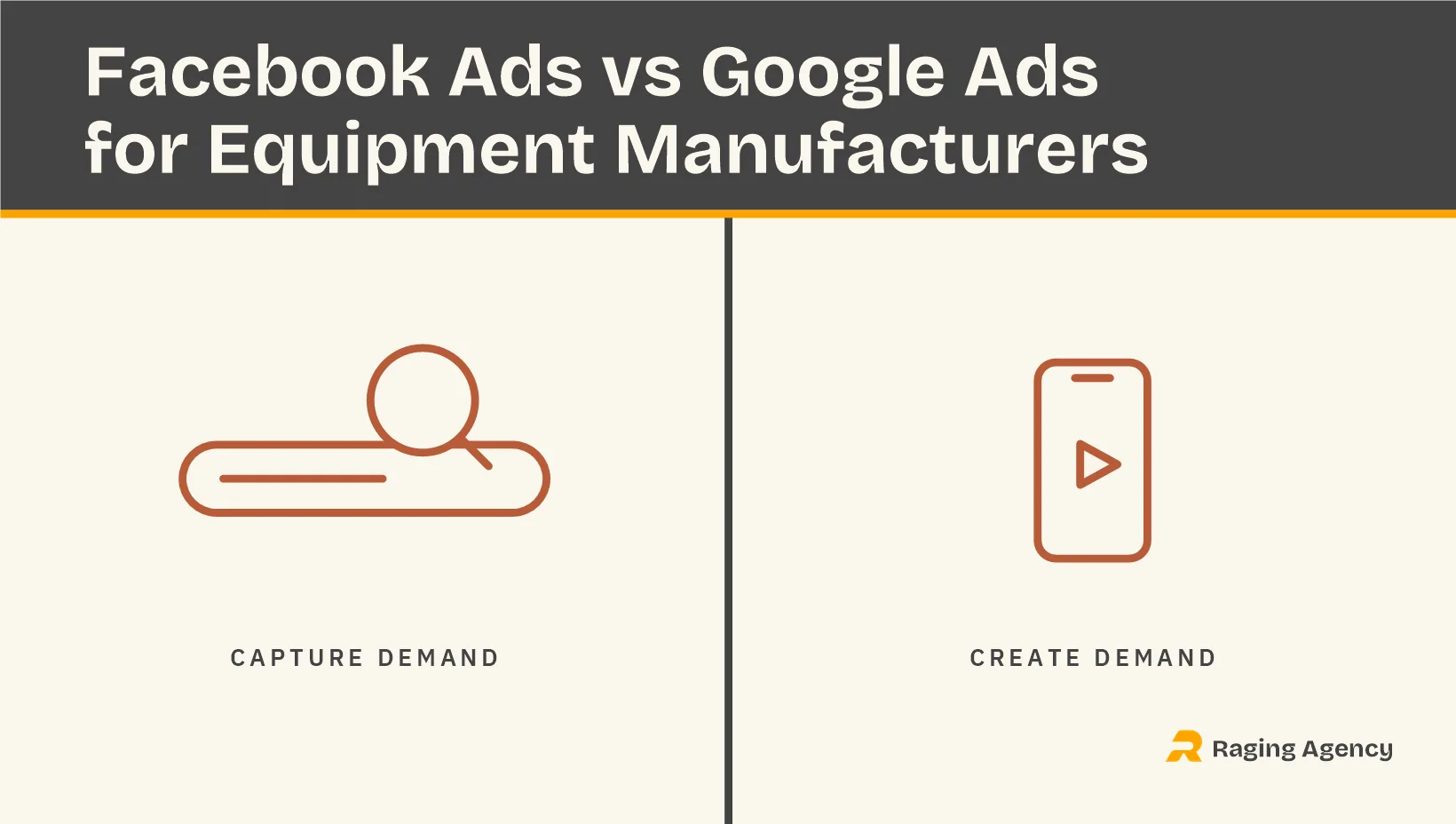
Google captures demand. Meta creates it. Almost every other difference flows from that one split.
On Google, the buyer types what they want. A person searching "hyperbaric chamber for clinic" has already decided the category deserves research. Your task is to match the query and make the demo request easier than it is on the next listing.
On Meta, no one asked. You interrupt a clinic owner's late-night scroll, or a consumer who has never heard of red light therapy, and hand them a reason to care. Meta is good at finding people who resemble your best buyers and showing them a product in motion. Interest is not intent, though, so the funnel behind the ad has to qualify harder. Hold Meta to Google's cost per lead and it will always look worse. Ask Google to create volume in a category nobody searches and it will always disappoint.
Facebook ads vs Google ads: side-by-side comparison for device makers
How the two platforms behave for a manufacturer selling capital equipment into clinics and studios:
| Criteria | Google Ads | Facebook and Instagram (Meta) Ads | |---|---|---| | Buyer intent | High. The buyer is searching the category, therapy, model, or spec. | Low to moderate. The buyer has not started searching. | | Best use | Capturing demand that exists, plus competitor and spec searches. | Building demand, video demos, retargeting. | | Targeting for clinic owners | Keywords and queries, which pull in some consumers too. | CRM lookalikes, retargeting, engagement audiences. No job titles. | | Creative format | Text ads, image assets, YouTube. Copy mirrors the query. | Short video, demo clips, carousels, lead forms. | | Compliance friction for device claims | Healthcare and medicines policy, country limits, possible certification. | Advertising Standards on health claims, personal attributes, imagery. | | Conversion tracking | Google tag, enhanced conversions, offline import through the click ID. | Pixel, Conversions API, CRM event upload. | | Sales cycle fit | Late stage research and short consideration windows. | Long cycles that need repeated exposure. | | Where it breaks | Categories with little search volume. Broad match drift. | Optimizing toward raw form fills. Copy loaded with claims. |
When should an equipment manufacturer use Google Ads?
Use Google Ads when buyers already search your category, your therapy, or your competitors by name. When that demand exists, leaving it to competitors is the costliest mistake on this list.
The query types that matter for device sales
The searches worth paying for land in a few buckets: - Category searches with commercial intent: "commercial red light therapy bed", "PEMF device for clinics". - Therapy paired with business context: "add cryotherapy to med spa", "hyperbaric chamber cost for a clinic". - Competitor and model searches, where policy permits. - Spec searches: pressure ratings, wavelengths, warranty and service terms, financing. - Distributor and dealer intent for your category.
Each bucket gets its own landing page. A spec search wants a spec sheet and a demo request. A cost search wants total cost of ownership, financing, and payback context. Pointing all of them at the homepage burns daily budget.
Where Google breaks for manufacturers
Google falls down in three places. New categories with almost no search volume. Broad match and Performance Max sliding into consumer queries, where someone wanting one session at a nearby spa clicks your ad for a commercial unit. And device types or countries restricted under the Healthcare and medicines policy. The basics are tight negative keyword lists, separate consumer and commercial campaigns, and a query review every week. For the full view of how Google treats regulated health offers, see our page on Google Ads for regulated health categories.
When should an equipment manufacturer use Facebook and Instagram ads?
Use Meta when your buyer does not yet know they need you, when your device is easier to grasp by watching it run, or when your cycle is long enough that staying visible counts for more than any single click.
Demand creation for clinic owners
Meta has no job title targeting, but clinic owners, med spa operators, and studio founders spend real time on Instagram and Facebook. The audiences that work: - Lookalikes seeded from your CRM list of buyers and qualified opportunities. - Engagement audiences of people who watched your demo videos. - Retargeting of visitors to spec, financing, and cost pages. - Interest layers around practice ownership, used as a first signal, not a filter.
The creative does the filtering. A video that opens in a treatment room, covers utilization and patient demand, and ends on a demo request is talking to an owner. A video about how good the therapy feels is talking to a consumer.
Demand creation with end consumers
Some manufacturers win by getting patients to ask clinics for the modality, which makes the owner's buying decision easier. Meta is the efficient channel for that category education, as long as claims stay inside your clearance or wellness positioning.
Retargeting and video demos across a long cycle
A capital purchase involves partners, a finance review, and a site visit. Meta retargeting keeps you in front of the buying group through that window: a customer interview after the demo, a financing explainer during the finance review, an installation walkthrough while they plan the room.
For how we build these programs, see Meta advertising for wellness brands.
How do Meta and Google handle medical device claims?
Both platforms limit health claims, but enforcement differs. Google cares most about what you sell and where, under its Healthcare and medicines policy. Meta cares most about how you phrase it, under its Advertising Standards.
Google's Healthcare and medicines policy
Google restricts some healthcare products, and certain medical device categories may need certification or can only serve in particular countries. Keywords, ad text, and landing pages all get reviewed, and a landing page claiming more than your cleared indications for use can sink an ad that would otherwise pass. We cover the mechanics in Google Ads Healthcare and medicines policy explained.
Meta's Advertising Standards
Meta's review leans on automation and reacts more to wording. Where device makers usually hit friction: - Health outcome claims that reach past what your evidence and clearance support. - Personal attributes language, meaning copy that implies you know the viewer's condition ("Struggling with chronic pain?"). - Before-and-after images in contexts Meta restricts. - Financing offers, which can fall under the credit special ad category and its targeting limits.
Unsure whether your category can run at all? Start with our breakdown of whether you can advertise medical equipment on Facebook.
The rules underneath both platforms
Federal rules sit beneath platform policy. A 510(k) device is cleared, not approved, and marketing has to stay inside the cleared indications for use. Products under the FDA General Wellness Policy keep claims at the general wellness level. The FTC expects competent and reliable scientific evidence behind health claims. Passing platform review does not make a claim lawful. Keep one counsel-approved claims library and pull copy for both platforms from it.
How should you structure a demo request funnel on each platform?
On Google, keep the demo request funnel short and specific. On Meta, make it qualify harder, since that traffic arrives colder.
The Google demo funnel
- A query-matched ad naming the category and a business result: utilization or payback.
- One landing page per intent group: category, spec, cost and financing, comparison.
- A short form: practice type, locations, timeline, financing needed.
- Instant routing to the right rep or distributor, with a calendar on the thank you page.
The Meta demo funnel
- A short video showing the device in a real treatment room and naming the buyer.
- An instant form or landing page, whichever yields better downstream quality in your CRM.
- Tougher qualifiers: decision maker role, current modalities, timeline, financing readiness.
- Retargeting for viewers and clickers who did not request a demo: case content, financing explainers, installation walkthroughs.
Instant forms bring cheaper volume and often weaker quality. A qualifying question trades some volume for leads sales will actually call. For a wider look at channels beyond paid social and search, see our guide to lead generation strategies for wellness equipment manufacturers.
Why offline conversion import decides which channel looks better
If both platforms optimize to form fills, whichever produces the cheapest form fills looks like the winner, and it is often the wrong one. Offline conversion import fixes that by feeding CRM outcomes back to each platform.
How the setup runs: - Capture the click identifier on every form submission. On Google that is the GCLID or its newer equivalents. On Meta it is the click ID plus hashed contact details sent through the Conversions API. - Define the CRM stages that count: qualified demo booked, demo completed, proposal sent, unit sold. - Push those stage changes to Google as offline conversions and to Meta as conversion events, on a recurring sync rather than a one-time upload. - Move bidding to the qualified stage once volume allows, keeping the form fill as a secondary signal.
With both platforms bidding on qualified demos, the comparison gets honest: cost per qualified demo by channel, campaign, and creative. It is also how Meta learns to tell a clinic owner with a financing plan from a curious consumer. Since a unit sold months later falls outside default attribution windows, the qualified demo, not the closed deal, is usually the right event to optimize toward.
How should equipment manufacturers split budget between Facebook and Google?
Let demand set the split, not habit. Fund Google until it captures the available high intent search volume in your category, then put the remaining daily budget into Meta to build the demand that feeds future searches and retargeting pools.
In practice: - Start Google at a daily budget that covers your core commercial queries without running dry early in the day. If impression share on your best queries is low because of budget, Google is underfunded. - Stop raising Google once impression share on qualified queries is high. Extra daily budget past that point mostly buys weaker queries. - Give each Meta campaign enough daily budget to exit the learning phase on a meaningful conversion event. Spreading Meta thin across many small ad sets is a common reason manufacturers decide it "does not work." - Rebalance monthly on cost per qualified demo from offline conversion data, not platform-reported leads. - Expect the split to move. As Meta builds awareness, branded and category searches tend to climb, pulling budget back toward Google.
Which channel should you start with?
Start with the channel your category's search demand can support. Check keyword volume for your category, therapy, and competitor terms first. - Established category with clear search demand (hyperbaric, cryotherapy, aesthetic lasers): open with Google, then add Meta for retargeting and expansion. - Emerging category with thin search demand (newer PEMF formats, novel recovery devices): open with Meta to build awareness and retargeting pools, then add Google as searches appear. - Consumer pull strategy: lead with Meta to consumers within your claims limits, while Google catches the clinic owners who start searching. - Heavy claim restrictions on one platform: start wherever your claims can run.
Where do LinkedIn and AI search fit around Meta and Google?
For most equipment manufacturers, LinkedIn and AI search play supporting roles. They do not replace Meta and Google.
LinkedIn adds job title and company targeting, which helps with hospital systems, multi-location groups, procurement teams, and distributor recruitment. It is usually a pricier way to reach independent clinic owners, who spend their time on Instagram.
AI search now shapes early research. Clinic owners ask AI assistants which hyperbaric chamber manufacturers are reputable, or how cold plunge stacks up against cryotherapy. Those answers draw on comparison pages, spec explainers, and financing guides. Clear, specific content on your site gets cited, and buyers who show up educated convert on fewer paid touches.
Decision framework: Facebook ads vs Google ads for your equipment line
Take these questions in order:
- Does your category have real commercial search demand? If so, Google goes first. If not, Meta does.
- Can your claims run on each platform? Check both policies against your claims library before you spend.
- Is your device easier to understand on video? Then Meta does more of the selling.
- Is your cycle long, with several people involved? Then Meta retargeting is close to required.
- Can your CRM send qualified demo stages back to both platforms? If not, fix that before scaling.
- Do you sell to large groups or procurement teams? Add LinkedIn for those accounts.
- Are you publishing content AI assistants can cite? If not, start now.
Most manufacturers land on Google capturing the demand that exists, Meta creating the demand that does not exist yet, and both bidding on qualified demos from the CRM.
Build a channel plan that fills your pipeline
If you manufacture hyperbaric chambers, PEMF devices, cryotherapy, red light systems, aesthetic devices, or recovery equipment, we will look at your search demand, claims, and CRM setup and map which channel should lead. Raging Agency is a Member of Meta Business Partners running Meta and Google programs for wellness and device brands.
When you are ready, book a discovery call to walk through your channel mix with Alex.
Frequently Asked Questions
Is Facebook or Google better for equipment manufacturers?
Neither wins in general. Google is stronger when buyers already search your device category, therapy, or competitors. Meta is stronger when your category is new, your device sells best on video, or your cycle runs long enough that retargeting matters. Most manufacturers run both, with Google capturing demand and Meta creating it, and both optimizing to qualified demos from the CRM.
Can medical device manufacturers advertise on Facebook?
Often yes, within limits. Meta's Advertising Standards restrict health claims, personal attributes language, and some before-and-after imagery, and financing offers can fall under the credit special ad category. Claims also have to stay within your FDA clearance or general wellness positioning. Many device categories perform well with copy pulled from a counsel approved claims library and creative built on the clinic business case.
Does Google Ads allow medical equipment ads?
Many, yes. Google's Healthcare and medicines policy restricts certain products, claims, and countries, and some medical device categories may need certification. Keywords, ad copy, and landing pages all get reviewed, and claims that go past the cleared indications for use can be disapproved. Check your category against the current policy before launch.
How do I know which channel is producing real sales opportunities?
Import offline conversions from your CRM into both platforms. Capture the click identifier on every form, define stages such as qualified demo booked, and sync them back to Google and Meta on a schedule. Then compare cost per qualified demo by channel. Skip this, and the channel with the cheapest form fills looks best even when sales never closes those leads.
Should I start with Facebook ads or Google ads?
Start with whichever channel your category's search demand supports. If clinic owners already search your device category, begin on Google, then add Meta for retargeting and expansion. If the category is new and few people search it, begin on Meta to build awareness and retargeting audiences, and add Google once category and branded searches show up.
About the author
Alex Evans is the founder of Raging Agency, the wellness marketing specialist behind the hyperbaric chamber engagement and patient acquisition systems for premium med spas, longevity clinics, and biohacking studios. Connect: @AlexEvans997 on Instagram, author archive.
Not sure which channel should lead?
Book a 30-minute Strategy Call.
We will look at your search demand, your claims, and your CRM setup, and map which channel should lead.