
Blog / Podcast
Inside World Spa Brooklyn: How Leonid Khanin Built a 50,000 Square Foot Wellness Destination That Brings 7 Spa Cultures Under One Roof
Most wellness operators tap out at a single sauna, a cold plunge, and a small treatment room. Leonid Khanin built a 50,000 square foot destination in the heart of Brooklyn that houses seven distinct spa cultures under one roof, welcomes more than 600 guests on peak days, and has already outgrown its original footprint.
Overview
That is not a typical wellness founder story. That is what happens when an architect trained on museums and presidential libraries decides to build a wellness brand from the ground up.
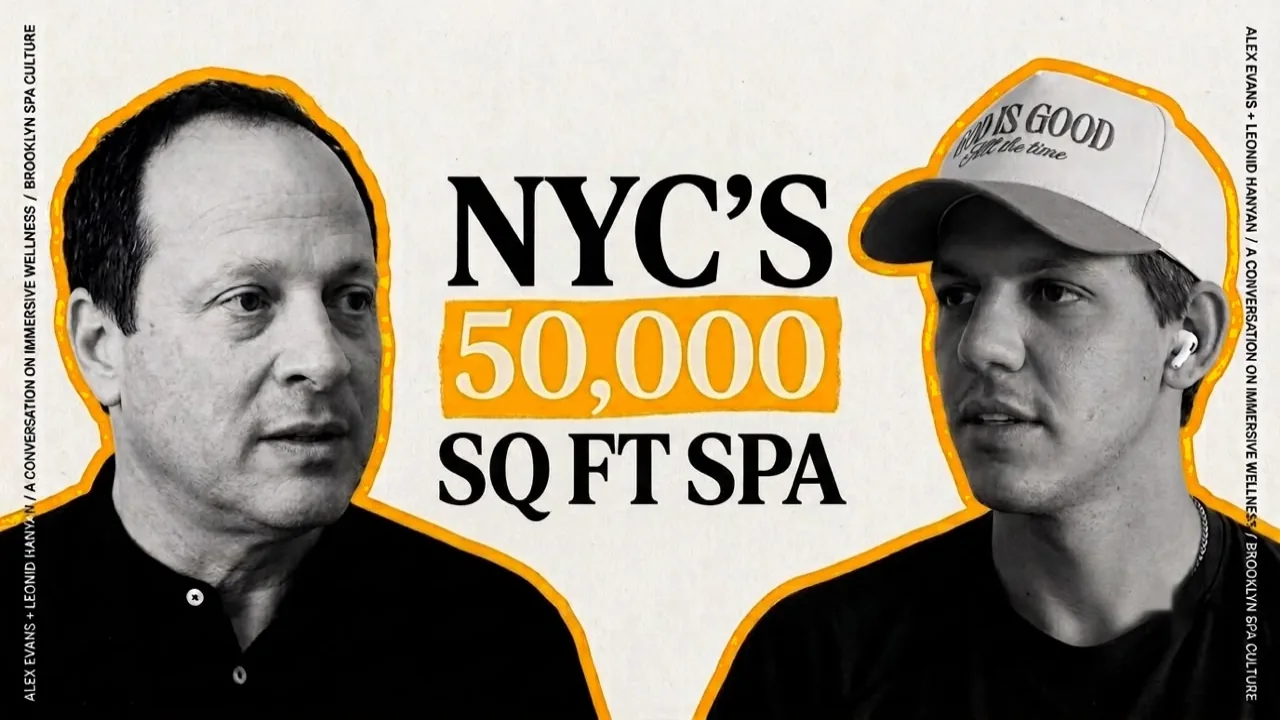
Leonid is the co-founder of World Spa, located at 1571 McDonald Ave, Brooklyn, NY 11230. The facility opened in November 2022 after Leonid and his team spent years designing, financing, and building the space from a Brooklyn parking lot. He sat down with Alex Evans, founder of Raging Agency, for an extended conversation about the operator-grade decisions behind the build, the cultural framework that shapes every cabin inside, the multi-generational visitor mix that has surprised even him, and the World Spa 2 currently in early planning. This piece pulls the operational insights from the conversation into one place. Watch the full interview below.
Watch the full podcast
Who is Leonid Khanin
Leonid Khanin is the co-founder of World Spa, a large-format wellness destination in Brooklyn, New York. Born in Moscow, Leonid arrived in New York in 1998 shortly after completing his master's degree in architecture at the Moscow Architectural Academy. He had passed his PhD exams and planned to spend a couple of years working in the United States before returning to academia. That plan changed. Nearly three decades later, he is one of the most consequential builders in the American wellness destination category.
Leonid's design background weighted heavily on museums and presidential libraries during his architectural career. That training shaped how World Spa was conceived and built. When Alex asked about how guests navigate 50,000 square feet without feeling lost or crowded, Leonid described the visit as a "journey," a term borrowed from museum choreography. The design gives guests distinct sequenced options based on what they want from the day: energy boost, stress release, or celebration with friends. Regulars build their own journeys and shift the cabin sequence and dwell time month over month.
The ground-up Brooklyn build (and why owning the building changed everything)
Most large-format wellness projects fail on the real estate math. Rent on a Brooklyn footprint that size would be brutal, and operators trying to service that rent typically compromise on finish quality, technology, or programming to protect margins. Leonid described the operating advantage that let World Spa avoid that trap.
The building at 1571 McDonald Ave was a parking lot when Leonid arrived in 2017. He and his team acquired the site and built the facility from the ground up. World Spa owns the building. That single decision cascaded through every subsequent operating choice. The team invested more in the interior finish, more in the technology, and more in the cultural authenticity of each cabin than they would have if they were building on someone else's real estate. The finish quality and material choices are directly reflected in how guests react to the space when they first walk in.
Owning the real estate also reshapes the second location math. World Spa 2, currently in early planning, will be built with the same ownership discipline. Leonid was direct that the new footprint may be larger than the current 50,000 square feet, and it will remain in New York, in a different part of the city than the current Brooklyn location.
The 7 to 8 spa cultures under one roof
The core intellectual insight behind World Spa is not the size. It is the cultural framework. Leonid described how the concept represents the spa traditions of Eastern Europe, Asia, and the Nordics through distinct dedicated cabins. Each cabin represents a specific cultural tradition, and every cultural tradition exists for a specific climatological reason.
His diamond metaphor: the more edges a spa concept has, the more valuable it becomes to the buyer. Seven or eight cultural edges are the current footprint. World Spa 2 will likely add more.
The cultural framework has real operational depth. Leonid walked through why Finnish saunas are dry, Turkish hamams are wet, and Russian banyas sit in the middle. His observation: each cabin type evolved as the physiological opposite of the mother-nature environment its original culture faced.
- A merchant traveling by camel through the Sahara Desert accumulated weeks of fine sand and dust in the lungs. The hamam, with its high humidity, was the tool for coughing that dust out.
- A Finnish villager surrounded by frozen lakes and cold rivers accumulated deep bone-cold. The dry heat of the Finnish sauna was the physiological restoration.
- A Russian in a climate with wet cold winters and dusty summers needed a middle-humidity heat that worked in both directions. The Russian banya sits at that balance point.
This is not marketing folklore. It is a real physiological framework, and it is why each cultural cabin at World Spa is authentic to its origin rather than a homogenized wellness experience. Many of the saunas and banyas were built in their country of origin (Russia, Finland, and elsewhere) and shipped to Brooklyn, because Leonid's team researched local craftsmanship and concluded that building in Brooklyn would not deliver the same authenticity.
Signature treatments: Aufguss and Veniki
Two treatments came up repeatedly in the conversation.
Aufguss is the German-origin ritual (the word translates roughly to "infusion") where trained sauna masters dance with towels inside a sauna to distribute aromatic infusions through the air. World Spa runs scheduled Aufguss sessions where a sauna master performs choreographed towel work with aromatic snowballs infused with essential oils. Leonid is meticulous about the aromas: all infusions are organic, sourced from a specific European brand, and quality-controlled. He said the price is higher, but the guest experience and safety justify it.
Veniki is the Russian banya treatment involving oak leaf branches, honey, and salt scrubbing. The treatment runs approximately 45 minutes. Leonid described it as one of the best recovery tools after a long trip or an illness, delivering multi-day energy after the session. He does the treatment for himself every two weeks.
Both treatments illustrate the World Spa positioning: not "sauna and cold plunge" but full-culture, high-touch, ritual-based wellness. That positioning attracts a different guest and commands different pricing than commodity spa competitors.
The multi-generational visitor mix that surprised even Leonid
One of the more operationally interesting observations from the conversation is the age distribution of World Spa guests. Leonid explicitly said he does not want to label demographics by generational categories, but he described a genuinely mixed audience: mothers, fathers, younger visitors curious about wellness, older regulars deep into the cultural traditions.
He credits the size for this. World Spa is big enough that a guest can spend the full day inside without exhausting the experience. That day-length dwell time creates a food service opportunity that shorter-format spas cannot capture: guests get hungry, they need hydration and nutrition throughout the day, and the on-floor food and beverage menu keeps them inside. The operating logic is that World Spa does not want guests leaving mid-visit.
Younger visitors gravitate toward smoothies, juices, and healthy options. Older regulars use the bar. Both cohorts coexist in the same facility.
The alcohol and wellness convergence
Alex raised the broader industry trend of declining alcohol consumption, especially among younger consumers, in the context of a wellness venue that also holds a full liquor license. Leonid's take was pragmatic.
World Spa holds a liquor license and operates a full bar in the mezzanine club area. Older guests do use it. Younger guests trend heavily toward juices and smoothies. Leonid's operational point: not offering alcohol on-site creates a bigger problem, because guests bring their own into the locker rooms, and self-managed drinking inside a wellness facility creates safety incidents that a licensed on-site bar with trained staff can prevent. Selling with structure beats not selling and losing control of the drinking behavior entirely.
The World Spa house recommendation to guests: complete the bathing sequence first, then use the bar afterward. Not as a rule, but as a health-optimization guideline. Guests appear to follow it.
What actually brings first-time guests back
Alex asked what converts a first visit into a repeat customer. Leonid's answer was operator-grade, not marketing-speak.
Three drivers surfaced:
- Staff hospitality at the point of guest arrival. How guests are greeted and how staff help them navigate their first journey has outsized influence on repeat visit likelihood. World Spa invests in floor staff training specifically for this reason.
- The physiological addictiveness of contrast therapy. The hot-to-cold contrast that defines Japanese onsen, Russian banya, and Finnish sauna traditions creates a genuine somatic memory. Guests come back because their bodies remember the feeling and prompt the return. Leonid noted that the skin, as the body's largest organ, drives this behavior at a level below conscious decision-making.
- Variety and cultural exploration. With 7 to 8 distinct cultural cabins under one roof, first-time guests do not exhaust the experience in a single visit. Return trips explore treatments they missed the first time, plus optional add-ons like massage, scrubs, and Veniki.
The retention math is what drives the business. Leonid did not share specific member LTV numbers on the podcast, but the day-length visit format plus cultural variety plus contrast-therapy dependency creates a compounding member relationship that shorter-format spas cannot match.
World Spa 2 is coming
Late in the conversation, Leonid confirmed that World Spa 2 is in active planning. He was measured about details:
- Location: New York, different part of the city than the current Brooklyn footprint
- Size: potentially larger than 50,000 square feet
- Timeline: not disclosed
- Cultural additions: potentially expanding beyond the current 7 to 8 cultures represented at the Brooklyn flagship
- Financing: he plans to apply the same ownership discipline used at the current location
He also acknowledged the multi-location possibility. His exact phrasing: "It might be actually not one location at once."
That signals real ambition. Building a second flagship at Brooklyn scale is a multi-year, capital-heavy undertaking. Multiple simultaneous flagships suggests either significant institutional financing has been secured, or Leonid is testing multiple sites in parallel. Either way, the World Spa brand is not stopping at one facility.
The wellness founder playbook takeaways
Several operational patterns from Leonid's build translate to any wellness founder trying to scale a large-format destination.
Own the real estate whenever possible. Every finish quality decision, technology investment, and programming choice gets easier when rent is not the annual budget line item consuming operating margin.
Design for a journey, not a service menu. World Spa does not sell a la carte spa services. It sells a sequenced full-day experience with cultural variety. That framing changes pricing power, dwell time, and guest lifetime value.
Authenticity compounds. The saunas built in their country of origin cost more upfront than locally built equivalents. Guests notice the craftsmanship difference. That authenticity becomes a competitive moat competitors cannot easily replicate.
Age-inclusive positioning outperforms narrow demographic targeting. World Spa attracts mothers, fathers, and younger wellness-curious guests in the same facility. The size and cultural variety let each cohort find their fit inside the same venue.
Food and beverage is a retention lever, not a side revenue stream. Longer dwell time means guests get hungry. Keeping them fed and hydrated on-floor prevents mid-visit departures. Bar service, done with structure, prevents locker-room drinking incidents.
The competitive set benefits everyone. Leonid was warm about competitor spas that borrowed World Spa treatments and adapted them. A rising wellness category grows the pie for every operator inside it, and the more sophisticated the average wellness guest becomes, the more World Spa's premium positioning pays off.
How Raging Agency fits
If you are operating or building a wellness destination and the marketing infrastructure underneath the business is not yet built to convert the demand your build deserves, the marketing system around the operation is the difference between "big beautiful facility that struggles at 30 percent occupancy" and "big beautiful facility that runs at capacity with a waitlist."
Most wellness destination operators walk into the first call with us with three to four marketing vendors stitched together (one for ads, one for the website, one for SEO, one for email), no central campaign architecture, and no offer-to-funnel-to-follow-up coherence. The fix is not adding more tactics. It is removing the friction between the existing pieces and rebuilding the system as one operational unit. We call it a rip and repair: keep what works, remove what does not, and rebuild the full funnel with one team accountable end to end.
That is what our free 30-minute Strategy Call is for. We will audit your current channel mix, compliance frame, and funnel architecture, and tell you which lever to move first before you commit to a new modality or a new location.
For a deeper reference on wellness marketing frameworks that translate across spa, HBOT, longevity, and med spa verticals, see our complete HBOT marketing guide for 2026 and our best wellness marketing agencies guide for 2026.
Full podcast transcript
The complete 37-minute conversation between Alex Evans and Leonid Khanin, co-founder of World Spa. Expand the panel below to read the full transcript of the episode.
Read the full conversation between Alex Evans and Leonid Khanin
[00:01] Alex Evans: Thank you so much for joining the podcast today. I'm joined with Leonid Khanin, the co-founder of World Spa, based in Brooklyn, New York. They opened up in November of 2022, actually, and they have 50,000 square feet. Thank you so much, Leonid, for joining me on the podcast today. How is your day going so far?
[00:20] Leonid Khanin: It was great, my pleasure.
[00:22] Alex Evans: Yeah, well it's really amazing to have you on here. Obviously New York City is one of the biggest cities in the entire world. I feel like that's kind of where everything's happening. And specifically, it's so impressive to me that you have a 50,000 square foot wellness destination in the heart of the city too. Can you rewind for just a moment? Can you tell me just a little bit about what even brought you to New York in the first place and what made you want to open up a spa there?
[00:46] Leonid Khanin: Yeah, that's easy. I moved to New York right after my thesis in Architectural Academy, and what brought me in was curiosity. So back then in 1998, I had just finished my masters in architectural academy in Moscow and was excited about becoming an architect and starting my own practice. Then I got a call from a construction company in New York who said, do you want to come and help us to build the architectural division within? And I was like, no, I was planning to start the PhD program and I already passed all the exams, which was not easy. But I thought, New York is some place that I want to try, and then a couple of years later I'll just move back. Well, that never happened. So when you're in New York longer than a year, you're sort of getting stuck in a good way. Because if you're a curious person, you're getting more and more curious. It's like a tunnel and you just keep exploring. And I'm still doing that, more than 25 years later.
[02:13] Alex Evans: So I guess I didn't realize this beforehand, but you're from Russia. You were born in Russia?
[02:17] Leonid Khanin: Yeah, I am. I'm from Moscow, which is quite unusual for people here. Most of the Russians in New York are from somewhere else. But yeah, I'm from the capital.
[02:29] Alex Evans: Why do you think that most of the Russians in New York are from somewhere else and not Moscow?
[02:35] Leonid Khanin: Well, it's complicated and might be a separate conversation. Most of the Russians that live here are immigrants or refugees, and they moved back in at the end of the 1980s or 1970s from places where the quality of life was very low, hard, and dangerous. Moscow was quite a different place, especially at the end of the 1990s. There were a lot of interesting things happening there. Now things have changed a lot. It's not the country I know, and I probably can hardly relate to whatever it represents now.
[03:30] Alex Evans: Yeah. Well, we'll certainly talk about what's happening in some of the major cities and metropolitan cities across the US and probably around the world a little bit later in the pod. The reason why I asked about the Russian stuff is I was actually adopted from Russia in the late 1990s. So I feel like a little piece of heritage is from back there. I've got a soft spot for when I'm talking to other Russians, so it's really cool to hear that that's part of your story, immigrating to the US as well. Do you feel like you being an immigrant and new to the US was a benefit or was that a hardship in terms of creating a new business?
[04:08] Leonid Khanin: I actually think it was a benefit in a way. As an immigrant, you take challenges in a different way. Nothing is given. Everything is for the taking. So you really have to try hard to get anything and don't expect miracles unless you make them.
[04:39] Alex Evans: I like that. Don't expect miracles unless you make them. That's awesome.
[04:42] Leonid Khanin: Yeah. And it works. It works for me, and not only for me, for a lot of people. I respect everybody who was born here, and I respect people who had an ambition to start their life, the new cycle of life here, like I've done and a lot of people I know.
[05:08] Alex Evans: Nice. So when you were turning World Spa from just a concept into actually turning it into a physical place and opening up those doors, did you have a really strong understanding of exactly what you were going for, or have you found that the spa itself has innovated and evolved over the years?
[05:27] Leonid Khanin: The good thing about the architectural education is you work with concepts from the beginning. It helps you to think that even if you have a very vague and blurry vision, you still think that you have it. And with World Spa, we as a team, and it wasn't only me, there were a few people working with me as partners, we had a very limited understanding of what we're building and how it's going to be accepted. There were a lot of ifs. And I'm just surprised to see how all of this mosaic or puzzle got into a picture and how it works now.
[06:21] Alex Evans: Do you think that there was a lot of innovation since the day that you opened up the doors back in 2022?
[06:28] Leonid Khanin: Within our business or just in general on the market?
[06:31] Alex Evans: In your business specifically.
[06:34] Leonid Khanin: Yeah. There were so many things, starting with bringing the entertainment component, which is not technology, it is people, talent. Even changing a menu in a restaurant that is serving people on the floor. Probably more than a dozen alterations, and all of them were based on need or interests of our guests and cultural insights of whatever we represent, even in combination pairing it with certain cabins and saunas and hamams. So it's still happening. I just got off a meeting and I'm planning to be on another one later today which is all about how this space and this business is changing towards better. There'll be a lot happening. It's a big facility with a lot of potential.
[07:36] Alex Evans: Yeah. It's definitely a big facility, and that's something that actually stood out to me. Obviously, 50,000 square feet is no joke. That's a huge facility. And the business side of my mind always goes to, how do we maximize the space? How do we make sure that people are not only having a really great time when they're here, but how can we make sure that we're making up for that? Because I'm sure your rent is quite high for having that kind of space. Is that something that you guys are considering, and how does that tie to keeping up with the times?
[08:15] Leonid Khanin: Well, first of all, we built this building from the ground up. When I arrived here in 2017, it was a parking lot. So it's our building. The rent situation is quite different, and that saves a lot. That is actually reflected in the quality of the concept, because one of the reasons why a lot of competition have to struggle and save on every finish or even on technology is that we knew that we're building in a building that belongs to us. So it's a very different approach, and it changes quite a lot. Maybe we invested a little more than we were probably supposed to, but it did reflect in the way people react to the interiors and everything. We continuously change things here, but the rent is not the main issue.
[09:20] Alex Evans: Sure. Can we dive in a little bit deeper then? What is the main issue that you're facing in a business like this?
[09:29] Leonid Khanin: I think the main issue for the business right now is to make the expenditure correctly. We have an ambition that it's not going to end with this 50,000 square feet. It's going to grow. We are in the process of looking for a perfect location for a new one, and I'm not going to be surprised if a new one based on whatever I've seen as potential sites will be bigger than that one.
[09:57] Alex Evans: Okay. So you want to go bigger than 50,000 square feet on World Spa 2?
[10:02] Leonid Khanin: Right. New York is a big city, and one of the major differences from the competition for World Spa is the size and the quality. And there are so much more. As you understand, one of the major components of World Spa is bringing different cultures under one roof, like the spa cultures, which is Eastern Europe, Asia, Nordic. They're all represented here as cabins. We probably represent about 7 to 8 different cultures under one roof. Why not represent 12? Why not add another few that will, you know, like with a diamond, the more edges you have, the better price for this thing. The more interesting it will be for the guests. So we need more space.
[11:04] Alex Evans: Do you feel a bit limited in the current space? You think that the 50,000 square feet just isn't able to house more cultures under its roof?
[11:13] Leonid Khanin: No, I think it's actually perfect here. It's a good balance. There's enough space for probably about 300 to 400 people at once enjoying it in the spa mode. Though in the peak days more than that come, and I'm not saying we probably usually the visit lasts about three and a half, four, or five hours. So we get more than 600 people easily through the day. But at once, probably the most comfortable number will be 300 to 400. Not more than that. If it gets more than that, it gets crowded.
[12:08] Alex Evans: Yeah. I haven't personally been to the spa but I'm super excited next time I'm in New York I'll definitely be taking a trip by. I'm very excited to see it in person. But you did mention that if there's too many people, my field is like crowded and cramped. How are you splitting up those people right now? Are people just naturally going into the different saunas and hamams and they're just organically splitting up? Or are there people that are sectioning off areas? What does that flow look like inside?
[12:37] Leonid Khanin: Well, again, my background in design, especially in designing museums and presidential libraries, that's where you get this special choreography of the visit. We call it in World Spa the journey. When you come in, you have certain options, different variations of your journey based on whatever you want from your visit. Is it a boost of your energy? Or is it releasing the stress? Or just a bunch of friends together celebrating somebody's birthday. So it's celebrational. All of these options will create different sequences of visiting different cabins. For our regular customers, they create their own journey. We have members who change the sequence of the cabins they visit and the amount of time they use in each on a monthly basis. But answering your question, it's all of what you mentioned. It's the amount of space we have, it's the entertainment that we propose for our guests. There are certain hours where our staff is walking around and announcing that there will be an event, let's say at one or at three, and inviting people to a specific sauna or hamam to see something new, to talk about something, or just to enjoy 15 minutes of somebody dancing with a towel and with the snowballs infused with a variety of aromas, which are probably one of the most popular things now in New York City. While in World Spa it's not the only thing that is offered, we do have events in the sauna healing, we have events in the aroma sauna, and we have the authentic events in the banyas which represent Eastern European culture.
[14:53] Alex Evans: Is there a standout that you prefer, that you really enjoy to go to as well?
[15:00] Leonid Khanin: I like the dance, the one that is called Aufguss. It comes from a German word, infusion. That's where our sauna masters are dancing with a towel but in a special way. They allow you to get the breath of the aromas, the potions that they mix together. I actually make sure that whatever they use for mixing these aromas are organic and really special, like fresh infusions that are coming from Europe and from a specific brand, so I know for sure that whatever our guests are breathing or enjoying, they are absolutely safe and the best quality. Sometimes it comes with a price. That's what I like. But there are also some treatments that I highly enjoy. Every two weeks I probably do them. This is Veniki. They are the branches of the oak leaves in combination with honey and salt scrubbing. That is about a 45-minute treatment, but after that you feel like not only your skin is new, but everything is amazing. You have a boost of energy for probably a few days. That's the best thing after a long trip or after you've been sick for a while. This thing will give you an amazing push. But that's not entertainment, this is more treatment, the last one that I mentioned.
[16:36] Alex Evans: Well, thanks for sharing exactly what your favorites are. I'm definitely curious. You mentioned the sauna masters. I've been to a couple of places as well too that have sauna masters that are doing the towels, and also have the ice balls. Are you seeing that other competitors and other spas are starting to ramp up and maybe take some of the things that you guys have been doing, and implement it into their spas as well? Is that something that you're noticing?
[17:06] Leonid Khanin: Sure. I actually enjoy it. I visited one place in Newton, Massachusetts, and they have this Kello Spa, and they were doing the same treatment as I just described. They were saying we got it from World Spa and we just slightly converted it to whatever we like and to our settings. What do you think about it? I really enjoyed it. It was different. And in terms of the entertainment, like the dances, there was a US championship in Bathhouse. I visited it and it was quite an interesting performance. Technically and emotionally it was quite an interesting thing to see. So you feel like you're visiting a theater, because it's even decorated with different lights and music and even sounds and special effects in the sauna. I was surprised with the creativity that the teams who are competing showed. That was quite an interesting experience. Not always when you go to a sauna do you expect a show. And especially with the actors who are dressed and dancing and they're sweating but at the same time it's intentional.
[18:38] Alex Evans: Yeah. When you hear about these other spots that you're going to, how are you finding out about them? Were they already on the map or were you recommended to them, or did they reach out to you and say, hey, we're so inspired by what you're doing?
[18:53] Leonid Khanin: In my case, actually, the last one, usually they're approaching me and saying, hey Leo, we're opening, there'll be a soft opening in two weeks, pick the date. It's a close circle in a way, because they are many, and they're becoming more and more, and it is a competition. But in a way I think they want to know what I think about what they've done. When they come here to explore, they ask me questions and I'm usually quite open. Not 100% open, obviously, because if they start to ask too many questions, it's a free market.
[19:40] Alex Evans: Yeah. I forget though, there's that quote that's like, "a rising tide carries all ships," which is like, as the wellness community continues to expand, that's also more customers across and just more people that are interested in the space. Have you been seeing that happen just generally with the competition rising, and have you seen wellness kind of booming as an industry?
[20:03] Leonid Khanin: Yeah. I'm specifically enjoying the fact of seeing a lot of younger generation. I don't want to label anything with the numbers or letters. I don't know why we have to. But yeah, I've seen at least three medium-sized places, facilities, opening within the last half a year. And I know about another four. That is really cool because I actually think overall that we benefit from each other. The smaller places, especially for the younger crowd, they're bringing the awareness. They're probably delivering to more people the knowledge that is very open and available in Europe. For example, in Finland, people grow up with it. In Russia as well. But in America, it's like, yeah, I have a sauna in my gym, I go there. That's pretty much every other person will say, yeah, I know about it. But do they enjoy it? If this sauna is somewhere you can spend more than five minutes without suffering and having a headache tomorrow, this is very different. That's what makes the professional approach special.
[21:36] Alex Evans: Yeah. I also think that there's a really big draw. I'm in the younger category, I'm sub-30, I'm 29 years old. I was just in Madrid actually and I visited a place called Bathhouse, I think it was called. It was such an incredible experience, something that I don't really get to experience all that often, but it was like very private, very intentional, with obviously sauna, steam, cold plunges, hot tubs, salt scrubs and everything, but in a very brutalist kind of themed, downstairs, concrete aesthetic. It just made the entire experience so unforgettable in many ways. I think as these new spas and competitors are opening up, it's cool to see that each one of them is taking their own approach to wellness as a whole. And I think you're completely right, honestly. I've personally noticed that wellness has been an expanding category. I find myself as one of those people inside of it, and it's really great to have new options and see that it's expanding as well.
[22:43] Leonid Khanin: Yep. There are some things that might be connected to hype, some things that might go away, but some things that are culturally supported that have been around for hundreds and hundreds of years. People were going in Africa or in the Middle East, they were going to hamams. There was a reason for that. It wasn't only health, it was in a way necessity. A lot of the guests, if I'm doing a private tour or explaining the concept, they're asking me, why is the Finnish sauna so dry? Why are the hamams so wet? Why is the Russian banya so in the middle? Interesting enough, the more I was researching it, the more I understood that those cabins are representing the opposite of what mother nature gives to these people. If, for example, you are a merchant and you're traveling with a camel through the Sahara Desert, what happens to you on the go? You've been spending weeks traveling through the desert, and there are all these sandstorms landing in your lungs. How can you get rid of all this dust? You go to hamam. You get all this humidity and you cough it out. So for them, hamam was the place to escape to get rid of extra dust. If you're in Finland and you're surrounded by cold lakes and rivers, your bones are freezing, what do you want? The dry heat. That's what you're getting in the sauna. And with the Russians, you want dry heat when it's wet outside and cold, and you want the wet heat when it's dusty. So it's a universal thing. That's the answer to why all of that creates this slice by slice pizza of our World Spa coverage of our culture.
[25:09] Alex Evans: I love that there's so much intention behind it, and I love that it's becoming so much more accessible. I'm really curious to talk about the future too. Just a little bit. We talked about it before this podcast even started, but drinking is on the decline, specifically alcoholic beverages, for some of the younger generations. And it seems like there is a push or gravitation towards wellness in general. Where do you really see wellness going in the next five to ten years realistically?
[25:43] Leonid Khanin: I think that wellness will be infused with entertainment. Will it be media? I don't know. Some kind of amazing laser projections, unique steam that will be triggering different emotional and healing properties in our physiology, who knows? There are so many technologies and so much availability. There's all this research on the plants and stuff, the herbs, and maybe psychedelics, who knows, they're becoming legal. Maybe a combination of that with the contrast therapy that you're getting in between sauna and cold plunge, and combination of all of that within the cultural aspect, will be probably the future. There are certain projects that are moving that way. World Spa is one of them, definitely. There is a project I think it's called Submersive in Texas. But the more you study it, the more you understand it. They create a lot of very nice and interesting images in AI. They're very sexy in a way. But the question is, as a builder, as a designer, when I see images like that, I'm thinking, well, that's a great idea, it looks amazing. I can draw or I can use AI and send a beautiful floating city in the clouds. Do I have the technology that will support that? For the investors, you know. First you have the idea, then you explain it, then you engineer it, and then you build it. It always works that way.
[28:04] Alex Evans: Are you having conversations like this when it comes to World Spa 2 and the second generation that you guys will be building? Are you trying to think outside of the norm?
[28:17] Leonid Khanin: Yeah, we do. And my team is quite supportive in the innovation. I've been experimenting with immersive saunas within the World Spa envelope. Though I do have, the more I'm testing it, the more questions I get, because in a way we want people to leave behind the media devices. And I'm not saying we're not requiring, as most of the spas do, to leave the phone in a locker. It is optional. If you want to keep it with you, it's up to you. We don't want to limit you with some strict rules. You have to respect other people and privacy, and so far it works.
[29:12] Alex Evans: Yeah, that's interesting to hear. Most of the spas I go to require us to leave the phone in the spa. That's really common. And I know that earlier I mentioned that there's been a decline in some of the alcohol consumption. But I've also been to places where they have a bar at the spa as well. I wanted to know what your thought on that is. Is that common? Is that something that you offer as well?
[29:35] Leonid Khanin: We do offer, we do have a liquor license and we have a full bar that is actually in the menu. In the club area on the mezzanine, we do have an open bar which is visible. It gives a lot of people options. We do advise to first do the bathing and then whatever drinking they want. We see that people are drinking a lot less. And I've heard that in places where they don't have any liquor on sale, they do have an issue with people actually drinking in the locker rooms. That's the last thing you want because this is uncontrollable, and then you get some accidents on floor, which we don't have. Though I understand, and I see that the younger crowd or younger visitors, they're not interested in the liquor. They're more interested in juices, smoothies, and stuff like that, more healthy stuff. And we do have this in the menu as well. World Spa is universal. We have a lot of people of different ages. What I like about it comparing to competition is that we're not limited to a specific age group. World Spa is a melting pot, like New York. We can see variety of all kinds of colors, any age groups, like mothers, fathers, and this is something that surprisingly happened. I think it's happening because World Spa is so big, so you can spend the whole day here. That's why the food is very important, because at some point you're getting hungry. It's a physiological, normal thing to get hungry, especially when you sweat. When you lose water and you dehydrate, you need to add different vitamins and whatever, and it is all available on the floor right there. We don't want you to leave. That's not the idea. And we also want you to come back.
[31:58] Alex Evans: Yeah, and what do you think brings somebody back? What makes a first time visitor into a repeat customer?
[32:07] Leonid Khanin: It's a good question because there are many things. At the beginning we didn't know what exactly brings people back. We thought, well, maybe a good design, maybe they'll be curious if they had a chance to explore everything or something they left for the next time. But what I noticed is that the way our team, people on the floor, help guests to navigate, how they feel welcome. This is a very important part. And in general, the aquathermal, this contrast therapy is quite addictive. It's good for you. There's nothing wrong about it. If you'll do a Japanese onsen where you go from a hot pool to a cold pool and then you get back, it's such an interesting feeling, and your skin, a lot of people forget that skin is our largest organ. It tells you what it likes. And then maybe there is a memory inside, some physiology, that tells you, okay, well, it's been two weeks, it's time to come back. And I want to try it again. Or you've tried the dry sauna and that's what you explored last time. Maybe this time you want to explore more wet hamams, or maybe even order some kind of treatment massage or scrub. There are many things. Variety, probably, that's what brings people back.
[33:50] Alex Evans: Nice. That's really cool, and I'm really excited to visit as well. I know that I'll probably do a massage, a scrub, hit the hamams, hit the sauna, hit the steam. Just do everything.
[33:59] Leonid Khanin: Yeah, let me know when you'll be coming. I'll be happy to do a tour, which is special because I know about pretty much every small piece of finish, why this wood is there, why this stone is there. There were so many cultural insights behind each of the cabins because a lot of saunas and banyas we actually built there, not here, not in the States. They were built some in Russia, some in Finland, in a crazy variety of places, because the research was showing that if we'd like to build them locally, we're not going to get the same craftsmanship.
[34:50] Alex Evans: Yeah. It makes sense. That just adds that extra layer of intentionality behind the spa itself. But we've only got a couple minutes left. I really want to just dig into World Spa 2 a little bit more. It's something that wasn't even on my radar. I didn't know that you guys were looking to open up another location. Is there anything you can share with us about when that location might be coming? Is that also going to be in New York City, or is that going to be in a different major city?
[35:17] Leonid Khanin: It's going to be in New York. It's just in a different part of it. I'm not going to expose yet on the size and the location. And it might be actually not one location at once. There's so much research. I'm just overwhelmed with the amount of new components that will land in a program, and I'm very excited because right now the selection will be very educated by seeing how people react on whatever we've done so far. So it's not going to be just a guess. A lot of things are different this time.
[36:06] Alex Evans: Yeah, I'm sure with all the knowledge that you've accumulated and all the feedback that you've gotten from customers over the years, I can't imagine what World Spa 2 is going to be like. So I'm really looking forward to that. But I really wanted to thank you for your time joining me today. Once again, if people want to find you, they can physically go to you. You're located in Brooklyn, New York at World Spa. You offer spa treatments, obviously a lot of the other functionalities that we discussed too, sauna, cold plunge, hamam as well. So if you are interested in visiting World Spa and discovering 50,000 plus square feet of spa-related activities, you should definitely go visit them. And if somebody's watching this and they would like to have a tour as well, is that something that they can opt in for, or is that publicly available, or is that something that's more private?
[36:56] Leonid Khanin: Well, it's not exactly publicly available. I choose when I see people who are interested, because we have, we had close to half a million visitors. Can you imagine if I'll be doing tours for everybody? But if there are people who are interested in this business or who have some connection and I feel it, and somebody recommends, or I feel like it's a fit, then I do a tour. But it's not happening every day or on some kind of schedule. Sometimes I do.
[37:31] Alex Evans: Understood. Well, you heard it here first. If you are in the industry and you're looking to maybe grow your own spa or have some unique insight, feel free to hit up Leonid Khanin. And I just want to say one more time, thank you so much for your time today, and it's a pleasure to meet you here. I can't wait to meet you in person as well too. Thank you so much.
[37:51] Leonid Khanin: Sounds great. Thank you.
World Spa Brooklyn FAQ
What is World Spa in Brooklyn?
World Spa is a 50,000 square foot wellness destination located at 1571 McDonald Ave, Brooklyn, NY 11230, co-founded by Leonid Khanin. The facility opened in November 2022 and brings 7 to 8 distinct spa cultures under one roof, including Finnish saunas, Russian banyas, Turkish hamams, and other Eastern European, Asian, and Nordic traditions. World Spa welcomes more than 600 guests through the doors on peak days, with an average visit length of 3.5 to 5 hours.
Where is World Spa located?
World Spa is located at 1571 McDonald Ave, Brooklyn, NY 11230. The address is a purpose-built facility that Leonid Khanin and his team acquired and built from the ground up starting in 2017. World Spa owns the building, which has shaped every subsequent design and operating decision at the facility.
Who is Leonid Khanin?
Leonid Khanin is the co-founder of World Spa. He was born in Moscow, Russia, and moved to New York in 1998 after completing his master's degree in architecture at the Moscow Architectural Academy. His architectural background includes designing museums and presidential libraries, which shaped how World Spa is designed as a sequenced journey experience rather than a traditional a la carte spa service menu. He has spent nearly three decades in New York and remains actively involved in the ongoing evolution of the World Spa concept.
What is Aufguss?
Aufguss is a German-origin sauna ritual (the word translates roughly to "infusion") where trained sauna masters use choreographed towel work to distribute aromatic infusions through the air of a heated sauna. Guests experience the aromas as the sauna master dances with a towel and aromatic snowballs infused with essential oils. World Spa runs scheduled Aufguss sessions where the infusions are sourced from organic European suppliers with rigorous quality control. Aufguss has become one of the most popular sauna traditions at large-format wellness destinations across the United States.
What is Veniki?
Veniki is a Russian banya treatment involving oak leaf branches (called "veniki" in Russian), honey, and salt scrubbing. The treatment runs approximately 45 minutes and leaves the skin renewed and the body with multi-day energy following the session. Leonid Khanin described Veniki as one of the most effective recovery tools after a long trip or extended illness, and personally does the treatment every two weeks.
Is World Spa opening a second location?
Yes. World Spa 2 is in active planning. Leonid Khanin confirmed on the Raging Agency podcast that the second location will be in New York, in a different part of the city than the current Brooklyn footprint, and may be larger than the current 50,000 square feet. He also acknowledged the possibility of multiple simultaneous flagship locations rather than a single-site expansion. Timeline, specific site, and cultural additions have not been publicly disclosed.
Does World Spa have a bar?
Yes. World Spa holds a full liquor license and operates a bar in the mezzanine club area. The house recommendation is to complete the bathing sequence first and use the bar afterward for optimal health outcomes. World Spa also offers juices, smoothies, and non-alcoholic wellness options that trend heavily among younger visitors.
What is the difference between Finnish sauna, Russian banya, and Turkish hamam?
The three traditions represent different climatological adaptations. Finnish saunas are dry, evolved to provide restorative heat to people surrounded by frozen lakes and cold rivers where bone-cold accumulates. Turkish hamams are highly humid, evolved to help travelers cough out fine desert dust that accumulated in the lungs over long trips through arid regions. Russian banyas sit at a middle humidity level, evolved for climates with both wet cold winters and dusty summers. World Spa represents all three traditions in dedicated authentic cabins, many of which were built in their country of origin and shipped to Brooklyn for installation.
About the author
Alex Evans is the founder of Raging Agency, the wellness marketing specialist behind $7M+ in hyperbaric chamber sales and patient acquisition systems for premium med spas, longevity clinics, and biohacking studios. Based in Miami. Connect: @AlexEvans997, author archive. For more wellness operator and marketing playbooks, follow Raging Agency on Instagram.
Build the marketing system that fills your wellness destination
Book a free 30-minute Strategy Call. We will audit your channel mix, compliance frame, and funnel architecture, and tell you which lever to move first.
Book your free Strategy Call