Blog / Podcast
How to Scale and Sell a Med Spa: Dr. Tali Arviv's Tampa Exit Playbook
Dr. Tali Arviv scaled Arviv Medical Aesthetics from one 1,400 square foot Tampa room in 2014 to a four-location Florida footprint, then sold to a private equity partner in October 2024. This is the full scale-and-exit playbook from the founder who actually did it.
Overview
Most med spa founders never exit. They either burn out and close the doors, sell the business at a discount when they run out of runway, or run the practice indefinitely without ever monetizing the equity they built. The private equity rollup wave that has been consolidating the aesthetic industry since 2021 has created real exit opportunities for a small group of operators who scaled at the right time and structured the right deal. But the founders who actually got the exit done are not usually the ones writing the LinkedIn posts about how they did it.
Dr. Tali Arviv is the exception. She founded Arviv Medical Aesthetics in Tampa in May 2014 with her mother as the operational engine and a single 1,400 square foot space. Over the next decade she scaled the business to four Florida footprints (Tampa, Miami, Ocala, and a Quad A-accredited 360 Surgery Center), navigated a recession-era operating squeeze in 2021 to 2023, fielded an 18-month parade of inbound private equity offers, and closed a partnership-style PE acquisition in October 2024. She is still the medical director of all three Arviv Medical Aesthetics clinical locations and now runs the Medspa Institute training company with her mother in parallel.
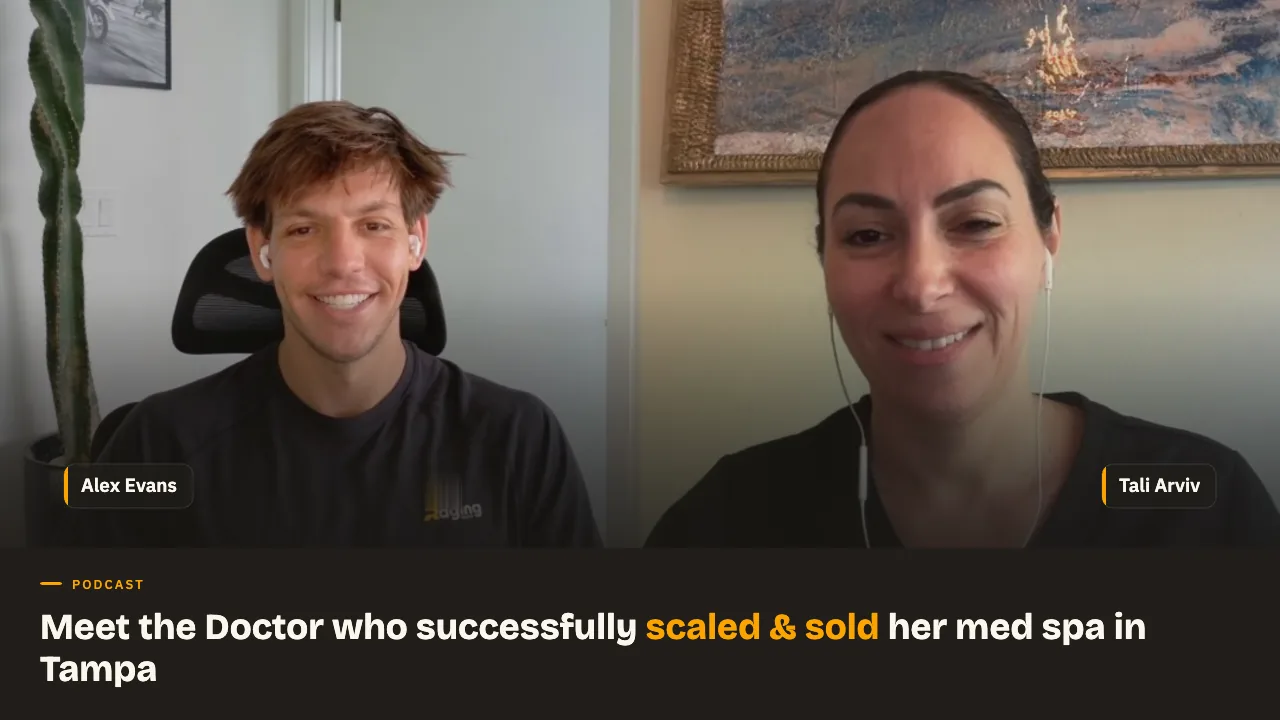
I sat down with Dr. Tali on the Raging Agency podcast for a full conversation on what the scale-and-sell arc actually looks like inside a med spa: the early cash-strapped years, the reputation-transfer strategy that made her Miami launch work, the marketing-spend evolution from two percent of revenue to ten, the deal-structure differences across the PE offers she fielded, and the lawyer mistake she almost made. This piece pulls the operator-grade insights from that conversation into one place. Watch the full interview below.
Watch the full podcast
Who is Dr. Tali Arviv
Dr. Tali Arviv is the medical director and founder of Arviv Medical Aesthetics, a multi-location Florida med spa group with footprints in Tampa, Miami, and Ocala plus a 360 Surgery Center. The Tampa flagship opened in May 2014. The Miami location opened in 2017 after Dr. Tali signed the lease in mid-2016. The Ocala location and the surgery center both opened in 2022. The brand sold to a private equity-backed strategic partner in October 2024, with Dr. Tali staying on as medical director through the rebrand transition scheduled to complete by the end of 2026.
Dr. Tali was originally trained as a hospitalist physician. The pivot into aesthetics came from her mother, who immigrated from Russia to Israel to the United States and built her own career through manicures and pedicures, laser hair removal certification in Orlando around 2005 to 2006 during the original "1-800-B-IDEAL" boom, and ultimately the founding of the Beauty and Health Institute in Tampa (formerly the Electrolysis Institute of Tampa), which now graduates over 200 estheticians and electrologists per year. The family business gene runs deep. Dr. Tali's brother now manages the Beauty and Health Institute. Dr. Tali's mother co-runs the Medspa Institute training company with Dr. Tali post-exit.
The throughline across all four of the family's businesses (Arviv Medical Aesthetics, Beauty and Health Institute, Medspa Institute, and the 360 Surgery Center) is education and operator infrastructure rather than chasing celebrity-style aesthetic marketing.
The 2014 Tampa start: bootstrapped, family-funded, founder-doing-everything
The Tampa launch in May 2014 looked nothing like the picture most aspiring med spa founders sketch out today. Dr. Tali knew nothing about running a business. Her mother rented the 1,400 square foot space, built it out, installed a laser machine, and brought in independent laser technicians who paid Dr. Tali a medical director fee for clinical oversight. That medical director revenue plus the laser room rental income kept the lights on while Dr. Tali learned the aesthetic industry from inside the practice. The Beauty and Health Institute (her mother's school) covered salaries during the first year. Dr. Tali did not pay herself a salary for the entire first year of operation.
The operator pattern in those first eighteen months: front desk, single esthetician, two laser technicians renting room time, no medical assistant. Dr. Tali was personally handling consents, photography, room turnover, product staging, and patient consults on top of the actual injectable and laser treatments. She saw patients at 7 p.m. if they could only come after work. She opened on Saturdays and Sundays. She was effectively the entire operating system.
By 2016, the revenue ramp had reached a point where Dr. Tali could hire her first nurse practitioner and pay herself a salary. The front desk team started enforcing 9-to-5 booking constraints. The chiropractor in the other half of the building moved out, which let Arviv Medical Aesthetics expand to the full 2,800 square foot space. That same year Dr. Tali signed the lease for the Miami location, which opened in 2017.
The Tampa-to-Miami expansion is the most operationally instructive piece of the early arc, because it is where Dr. Tali figured out the reputation transfer mechanic that most multi-location med spa founders never crack.
The Miami expansion and the reputation-transfer mechanic
The Miami location was supposed to be a 50-50 partnership with another physician who reached out to Dr. Tali wanting to open a Miami footprint and serve as the local medical director. The two physicians found the real estate, drafted the operating structure, and prepared to sign the lease. The partnering physician backed out at the last minute to fund her wedding instead.
Dr. Tali had roughly $70,000 in personal savings at that point. A contact at Bank of Tampa extended a construction loan and working capital line based on the Tampa P&L. Dr. Tali and her mother drove down to Miami one Saturday per month, performed full-body laser hair removal sessions on Groupon-driven leads, sold each Groupon patient a five-to-six-session treatment package, and used the package revenue to cover the Miami location's monthly rent. The operation ran lean for the first six to nine months until organic local demand caught up.
The reason the Miami launch worked at all was the reputation transfer from Tampa. Patients searching for a Miami med spa in 2017 could see that Arviv Medical Aesthetics already had years of Tampa reviews, a portfolio of before-and-after photos, an established physical brand, and a credible medical director. New patients trusted the Miami location not because of anything the Miami location had done yet, but because they could verify the Tampa location had been doing it for three years. That trust transfer is what made Groupon-led acquisition profitable in Miami when Groupon-led acquisition almost never works for an unknown med spa.
The lesson for any multi-location med spa operator: location two has a structural advantage that location one never has, because location one's credibility carries over. Most operators waste this advantage by treating location two like a new brand. Dr. Tali leaned into it.
The marketing-spend evolution: from 2% to 10% of revenue
One of the most operationally interesting parts of the conversation was Dr. Tali's framing of how her marketing spend changed over the ten-year arc of the business.
Through 2021, Arviv Medical Aesthetics spent roughly 2 percent of revenue on marketing. The growth engine was reputation, word-of-mouth referrals, and reviews. SEO at the Miami location had been added when that footprint opened, and the same SEO partner eventually supported all of Dr. Tali's businesses, but paid Meta advertising was not part of the marketing mix for almost the entire scaling phase of the company. Demand was high enough that paid acquisition was a margin tax, not a growth lever.
After 2021, the broader economy shifted and patient acquisition got materially harder. Marketing spend climbed to roughly 10 percent of revenue, and Dr. Tali added Meta advertising into the mix for the first time. That 5x increase in marketing intensity reflects the structural change in the patient acquisition cost across the aesthetic industry between the 2014-to-2021 boom years and the 2022-to-2026 normalized environment.
The takeaway for operators running med spas today: the 2 percent marketing spend that worked for established practices through 2021 no longer covers the patient acquisition cost in a normalized aesthetic market. Most operators we audit at Raging Agency are still budgeting at 2 to 4 percent because that is what their P&L history shows. Per Raging Agency client engagement data across med spa accounts 2023 through 2025, the reality on the ground in 2026 is that a healthy med spa marketing budget runs closer to 8 to 12 percent of revenue for a growth posture and 5 to 7 percent for a maintenance posture, with the exact percentage tied to the practice's reputation depth, geographic competition density, and modality mix.
The demographic differentiation across Tampa, Miami, and Ocala
The other operational lesson from Dr. Tali's multi-location playbook is that the patient demographic is not the same across her three Florida footprints. Tampa, Miami, and Ocala draw different age groups, different skin types, different income tiers, and respond to different marketing channels. The Miami patient base skews younger, more concentrated in the affluent South Beach and Brickell zip codes, and responds more aggressively to Instagram Reels and Meta-paid acquisition. The Tampa patient base is more diversified across age and income and converts better through SEO and review-driven organic search. Ocala is a smaller, more rural market with a different skin type distribution and a different price ceiling.
Most multi-location med spa marketing strategies fail because the operator treats the brand as one unified avatar and runs the same campaigns across every footprint. The brand should stay consistent. The channel mix, ad creative, offer structure, and follow-up sequencing should be customized to the local patient base.
For a deeper breakdown of how med spa patient acquisition systems should be structured for multi-location operators, see our med spa marketing resources.
Why patients are now finding med spas through ChatGPT
One of the most forward-looking observations Dr. Tali shared was that her front desk team has started getting patients who answer "how did you hear about us" with "I asked ChatGPT what the best place is for this service."
This is the AEO (Answer Engine Optimization) shift in real time. AI engines (ChatGPT, Perplexity, Gemini, Claude) are increasingly the first stop for high-intent patient research, especially for younger affluent patients in metro markets like Miami. The patient does not look at the Google search results page. They ask the AI engine directly: "what is the best med spa in Brickell for laser resurfacing." The AI engine returns a curated answer based on the entity data it has indexed about the candidate businesses.
The implication for med spa operators: SEO alone is no longer enough. The practice needs structured entity data, citations across high-authority sources, schema markup, and a clean content footprint that AI engines can ingest. For the full breakdown of how to structure a wellness or aesthetic brand for AI search visibility, see our med spa SEO and AI search visibility service.
The exit: 18 months of PE inbound, three deal structures, one lawyer mistake
The exit conversation is where the conversation got most operationally specific. Dr. Tali fielded private equity inbound offers across an 18-month window leading up to the October 2024 close. The offers came in roughly every two months as the broader med spa consolidation wave heated up.
The three deal structure archetypes she encountered:
1. Flat buyout. The acquirer purchases the business outright at an agreed valuation. The founder can stay on as an employee or exit cleanly. No ongoing equity participation.
2. Revenue-share employment. The acquirer owns everything. The founding physician stays on as the clinical operator and is compensated through a 30 percent revenue share on the work they personally generate. No salary, no equity, no second bite.
3. Majority-equity partnership with rollover. The acquirer takes majority equity (in Dr. Tali's case, roughly a 45/55 split). The founder retains minority equity, stays on the business, draws a salary, and gets a "second bite of the apple" when the acquirer recapitalizes or sells in a subsequent transaction (typically three to seven years out).
Dr. Tali chose the third structure. The deciding factors were the employee impact (the partner offered better benefits and pay for her existing staff), the partnership-style relationship with the acquirer's leadership team, and the second-bite economics. Valuations across all the offers landed in the 1.2x to 1.5x of gross revenue range, with the variance driven by deal structure, geographic concentration, modality mix, and the size and recency of recent capital expenditures.
The lawyer lesson: Dr. Tali initially worked with a business broker to formalize her sale-side position. She did not have an attorney review the broker agreement carefully enough. The broker contract embedded a permanent equity haircut on her go-forward salary, earnout, and second-bite proceeds that she did not catch until the structure of the actual deal forced her to read the broker contract in detail. She ultimately exited the broker relationship and postponed the sale process by several months to clean up the agreement. The recommendation she would give to any other med spa operator considering a sale: hire a transaction attorney from the first conversation, regardless of how small your business feels. The fine-print equity penalties in standard broker contracts can permanently reduce the founder's net proceeds in ways that are not obvious until the actual deal mechanics force them to the surface.
The 2021 expansion squeeze that almost broke the business
The exit story is incomplete without the operating squeeze that preceded it. In 2021 Dr. Tali expanded aggressively: she signed the leases for the Ocala location and the 360 Surgery Center, and she expanded the Tampa flagship to 3,000 additional square feet. The capital expenditure on those three projects landed in the same operating year that the macro economy turned and patient acquisition cost climbed.
The result was three years (2022, 2023, and into 2024) of "head above water" operations. Dr. Tali drew down on a credit line to make payroll. She declined to terminate employees or cut hours. She climbed the marketing spend from 2 percent to 10 percent of revenue to compensate for the harder acquisition environment. The Arviv Medical Aesthetics P&L was healthy enough to survive the squeeze but not healthy enough to make the founder comfortable continuing to bear all of the equity risk alone.
That operating posture is what made the PE outreach attractive in 2023 and 2024. The right deal structure transferred a meaningful portion of the equity risk to a partner with deeper capital reserves while preserving Dr. Tali's upside through the rollover and the medical director role. For med spa founders sitting on similar operating-squeeze dynamics in 2026, the same logic applies. The right time to entertain PE inbound is not when the business is at its peak. It is when the founder has built durable enterprise value and is no longer comfortable carrying all of the downside.
What Dr. Tali is doing now: Medspa Institute and the 360 Surgery Center
Post-exit, Dr. Tali is running two parallel businesses in addition to her medical director role at Arviv Medical Aesthetics:
Medspa Institute is the training company Dr. Tali co-founded with her mother after the October 2024 close. The Institute runs hybrid online plus in-person training for estheticians and injectors at all skill tiers (entry-level certification through advanced injector training), with one-on-one and group programs. The Institute leverages Dr. Tali's clinical expertise plus her mother's school operations experience from the Beauty and Health Institute.
The 360 Surgery Center is the Quad A-accredited surgical facility that opened in 2022 and serves as a host facility for plastic surgeons performing procedures on their own patients. The surgery center transferred to the acquirer along with the Arviv Medical Aesthetics clinics but continues to operate under Dr. Tali's clinical oversight as a hosted-surgeon facility.
The throughline across both businesses is the same one that has run through Dr. Tali's career since 2014: build durable operator infrastructure, partner with family, lean into education, and let reputation compound.
How Raging Agency fits
If you are operating a med spa today and either trying to scale to a second or third location, optimize your marketing spend for the 2026 normalized acquisition environment, or build the kind of durable enterprise value that makes a future exit possible, the marketing infrastructure underneath the business is what makes the difference.
Most med spa operators we audit at Raging Agency walk in with three to four marketing vendors stitched together (one for ads, one for the website, one for SEO, one for email), no central campaign architecture, and no offer-to-funnel-to-follow-up coherence. The fix is not adding more tactics. It is removing the friction between the existing pieces and rebuilding the system as one operational unit. We call it a rip and repair: keep what works, remove what does not, and rebuild the full funnel with one team accountable end to end.
That is what our free 20-minute Strategy Call is for. We will audit your current channel mix, compliance frame, and funnel architecture, and tell you which row to fix first.
Related reading: Best med spa marketing agencies 2026 and the med spa marketing hub.
Med spa scale-and-sell FAQ
How do you sell a med spa to private equity?
The most common deal structures for selling a med spa to private equity are: flat buyout (the acquirer purchases the business outright), revenue-share employment (the acquirer owns everything and pays the founding physician a percentage of personal production), and majority-equity partnership with a minority rollover (the acquirer takes majority equity, the founder retains a minority stake and receives a second-bite-of-the-apple payout when the acquirer recapitalizes). Dr. Tali Arviv used the third structure for her October 2024 exit. Valuations for med spa transactions in the 2024 to 2026 environment typically land in the 1.2x to 1.5x of gross revenue range, with variance driven by deal structure, geographic concentration, modality mix, and recent capital expenditures.
What is a typical med spa valuation in 2026?
Based on the private equity offers Dr. Tali Arviv fielded across an 18-month window leading up to her October 2024 close, med spa valuations in the current environment range from 1.2x to 1.5x of gross annual revenue. Variance within that range is driven by deal structure (flat buyout valuations tend to be lower than partnership rollover valuations), geographic concentration (single-location operations price differently than multi-location footprints), modality mix (injectables and laser-heavy practices price differently than wellness-heavy practices), and recent capital expenditures (a recently expanded practice may have depressed near-term EBITDA that affects the multiple).
Should I hire a broker or an attorney when selling my med spa?
Hire a transaction attorney from the first conversation. Dr. Tali Arviv's experience selling Arviv Medical Aesthetics included a costly broker contract mistake where the broker agreement embedded permanent equity haircuts on her go-forward salary, earnout, and second-bite proceeds. She exited the broker relationship and postponed the sale process by several months to clean up the contract. The fine-print equity penalties in standard broker agreements can permanently reduce founder net proceeds in ways that are not obvious until the actual deal mechanics force them to the surface. An attorney spotting those penalties before the broker contract is signed is the highest-leverage spend in the entire exit process.
How much should a med spa spend on marketing?
The marketing-spend benchmark for a med spa has shifted materially since 2021. Pre-2021, established med spas (including Arviv Medical Aesthetics through that period) often ran on 2 to 4 percent of revenue for marketing because reputation and word-of-mouth carried the demand engine. Post-2021, normalized patient acquisition cost has climbed to the point where a healthy growth-posture med spa marketing budget runs closer to 8 to 12 percent of revenue, with 5 to 7 percent supporting a maintenance posture. Reputation depth, geographic competition, and modality mix all affect where a specific practice should land in that range.
How did Dr. Tali Arviv start her med spa?
Dr. Tali Arviv opened the Tampa flagship of Arviv Medical Aesthetics in May 2014 with her mother as the operational engine and a single 1,400 square foot space. The first year was bootstrap-funded by her mother's Beauty and Health Institute (a Tampa esthetics school) covering staff salaries plus medical director fees from independent laser technicians renting room time. Dr. Tali did not pay herself a salary for the first year. The business scaled to a 2,800 square foot Tampa footprint by 2016, added a Miami location in 2017, and added Ocala and a 360 Surgery Center in 2022.
What is the Medspa Institute?
The Medspa Institute is a hybrid online plus in-person training company co-founded by Dr. Tali Arviv and her mother after Dr. Tali's October 2024 exit from Arviv Medical Aesthetics. The Institute trains estheticians and injectors at all skill tiers, including entry-level certification, advanced injectables training, and one-on-one and group programs for providers already operating in the aesthetic industry. The Institute is operationally connected to the family's existing Beauty and Health Institute (a Tampa esthetics school that graduates over 200 students per year).
How do you scale a med spa to multiple locations?
The most reliable scaling mechanic Dr. Tali Arviv demonstrated across her Tampa, Miami, and Ocala expansion arc is reputation transfer: a second location inherits the first location's review base, before-and-after portfolio, brand recognition, and clinical credibility. This makes second-location patient acquisition materially cheaper than first-location patient acquisition, including through marketplace channels like Groupon that almost never work for unknown brands. The practical implementation requires consistent branding across locations, a centralized review and reputation management system, and explicit "as seen at our Tampa location" messaging on the new-location website and social presence during the launch phase. Brand consistency does not mean ignoring local demographic differences. The brand should stay consistent across footprints. The channel mix, ad creative, offer structure, and follow-up sequencing should be customized per location.
Where are the Arviv Medical Aesthetics locations?
Arviv Medical Aesthetics has three med spa locations in Florida (Tampa, Miami, and Ocala) plus a 360 Surgery Center, a Quad A-accredited surgical facility used by plastic surgeons performing procedures on their own patients. Dr. Tali Arviv remains the medical director of all clinical operations through the brand transition period following the October 2024 PE acquisition. The brand is expected to rebrand to the acquirer's national brand identity by the end of 2026.
Who is Dr. Tali Arviv?
Dr. Tali Arviv is the founder and medical director of Arviv Medical Aesthetics, a multi-location Florida med spa group with footprints in Tampa, Miami, and Ocala plus a Quad A-accredited 360 Surgery Center. She founded the Tampa flagship in May 2014 with her mother as the operational engine, scaled the business across four Florida footprints over the next decade, and sold the brand to a private equity-backed strategic partner in October 2024 through a majority-equity partnership structure that preserved her medical director role and minority equity position. Originally trained as a hospitalist physician, Dr. Tali pivoted into aesthetics through her family's existing Beauty and Health Institute. Post-exit, she co-founded the Medspa Institute training company with her mother and continues to operate as medical director across the Arviv Medical Aesthetics clinical footprint through the brand transition period.
About the author
Alex Evans is the founder of Raging Agency, the wellness marketing specialist behind $7M+ in hyperbaric chamber sales and patient acquisition systems for premium med spas, longevity clinics, and biohacking studios. Based in Miami. Connect: @AlexEvans997, author archive. For more med spa operator playbooks and wellness industry interviews, follow Raging Agency on Instagram.
Build a med spa worth scaling and selling
Book a free 20-minute Strategy Call. We will audit your channel mix, compliance frame, and funnel architecture, and tell you which lever to move first.
Book your free Strategy Call